Using the drugs we have more effectively
The readout of the PROFILE trial after 5 years shows dramatic benefit from top-down treatment for Crohn's disease.
Jeff
The setup of the trial
Crohn’s disease (one of the common types of inflammatory bowel disease) is tricky to treat because patients with similar presentation at first diagnosis can have dramatically different trajectories. For some, an initial dose of corticosteroids can stop the acute flare, and they have quiescent disease for years. For most, however, the inflammation returns and worsens, and was historically treated in what’s known as a “step up” approach: start with inexpensive drugs that have been around for 60 years, and see what happens. If the patient gets better, great: you’ve saved money and avoided potential side effects from biologics; if not: you “step up” to the more advanced therapies.
For nearly 20 years, however, there has been evidence that “top down” therapy, where you start immediately with advanced therapy, can avoid lots of poor outcomes: give every newly diagnosed patient a biologic drug (mostly anti-TNFs, which are off patent, and thus not too expensive) to maxmize the chance they have a favorable disease course. The PROFILE trial was designed to test this approach, and just published the 5-year outcomes (after reporting a couple of years ago on results a year in).
Top-down therapy for Crohn’s should now be universal
The effects in the trial were dramatic! They found an adjusted hazard ratio bigger than 5(!) for step-up (red in their Figure 1, below) versus top-down (blue) for abdominal surgery, one of the very bad outcomes for Crohn’s disease.
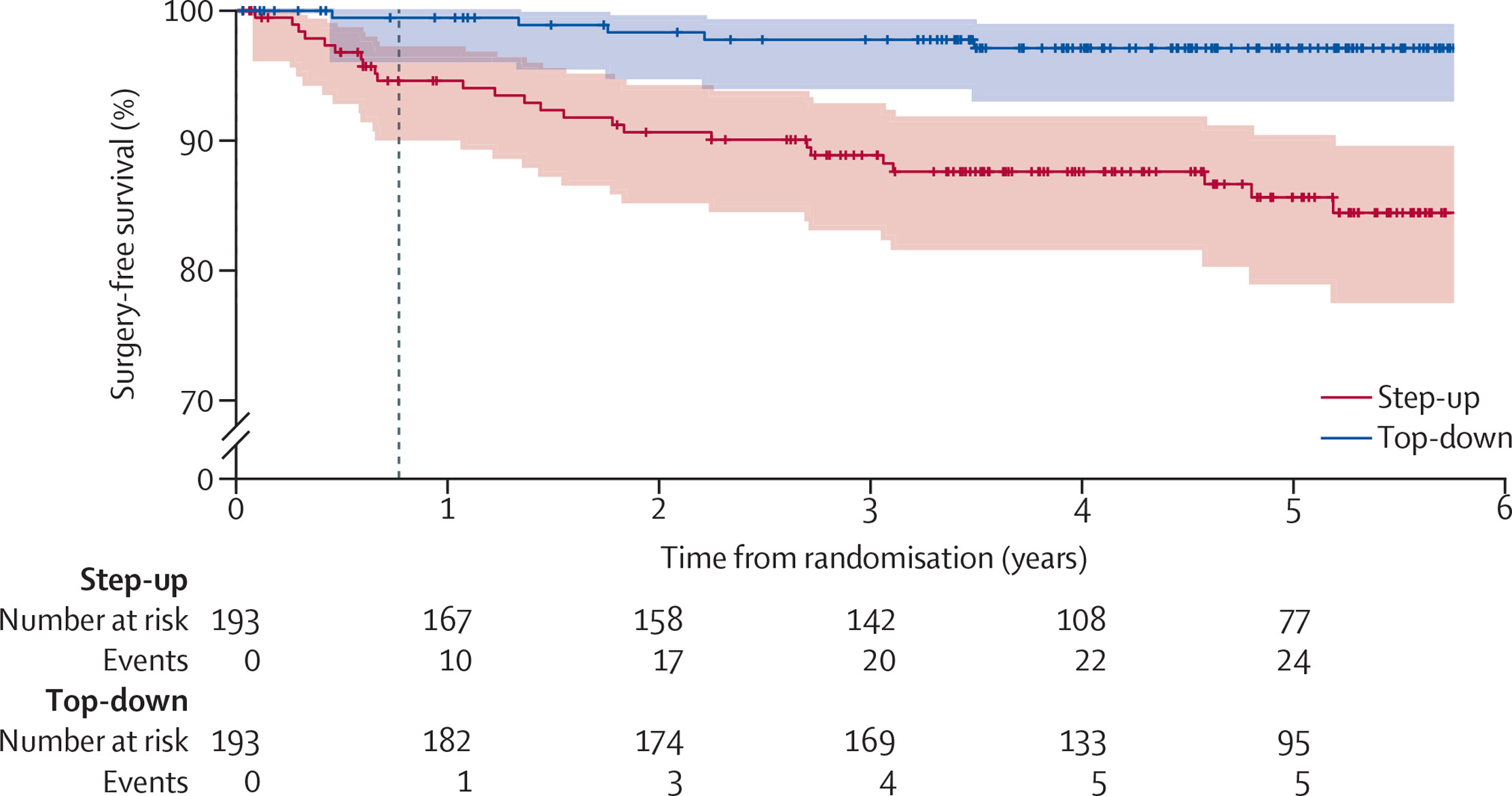
These results were bolstered by continued maintenance use of advanced therapy (in this case all patients were on the first line anti-TNF, infliximab), in contrast to some earlier trials. I think the results speak for themselves (even if they are not quite as amazing as my favorite survival curve of all time). Anyone with a new diagnosis of Crohn’s disease should default to advanced therapy as the first treatment they receive, and should continue on it for a year to keep their disease tamped down.
Is Crohn’s cured?
The surgery rate above is pretty minimal for the top-down group. Does that mean Crohn’s is cured? I think not quite yet. For one thing, even people who avoid the worst outcomes (e.g. debilitating gastrointestinal surgery) still end up in the hospital a lot:
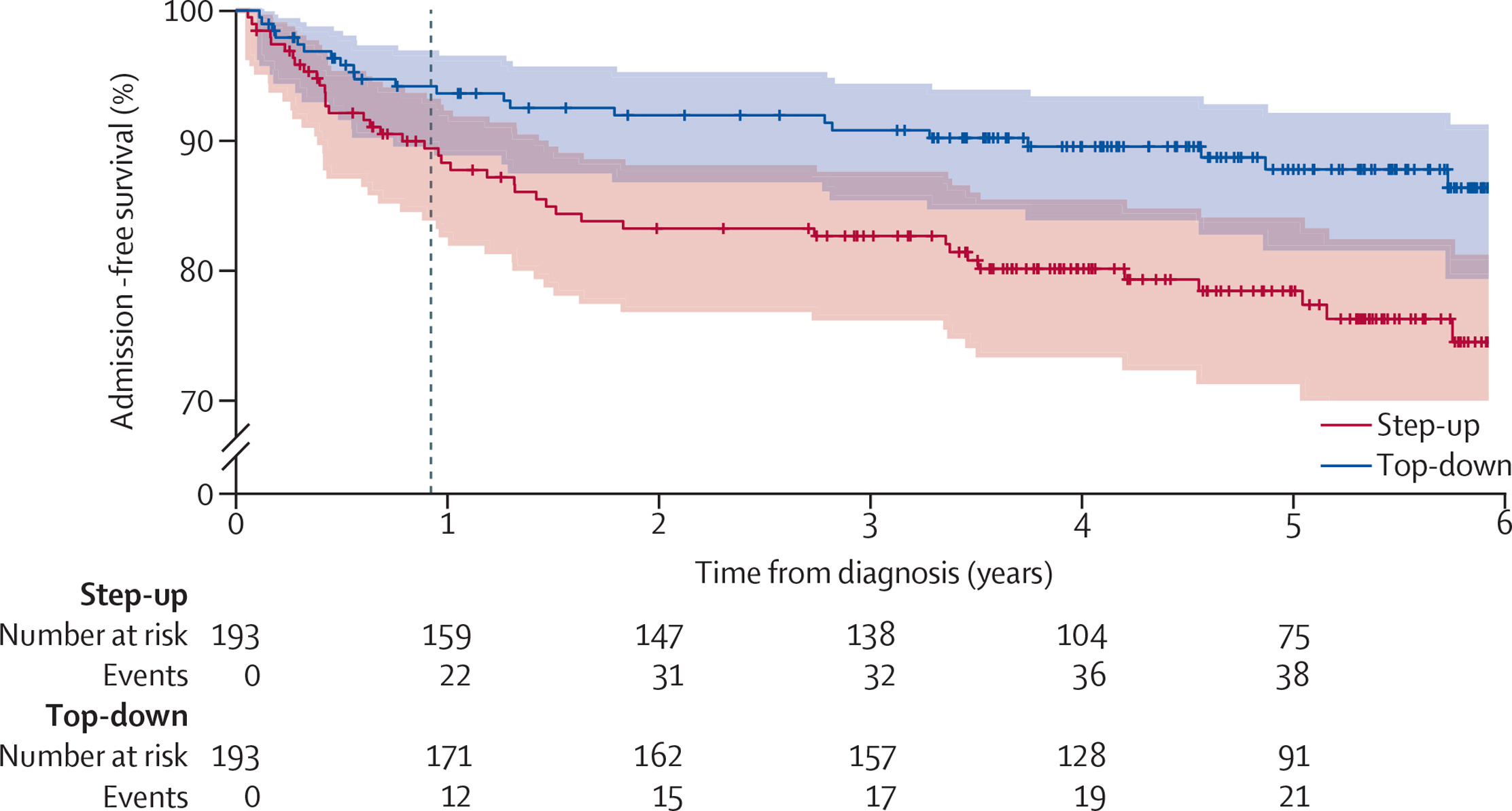
Top-down therapy is much better, but both curves still show lots of people being admitted to hospital. And even though 5 years is a long follow-up for a trial, in reality these individuals are living with this disease for their entire lives, and the average age of diagnosis is in their early 30s. We still need new therapies, as well as tools to use them effectively.
Who responds and who doesn’t?
I have so far not mentioned an important part of the original design of the PROFILE trial, which was to test a promising transcriptional biomarker of disease progression. The investigators hoped that it could be used at diagnosis to identify a subset of patients who would most benefit from top-down therapy. It turned out that in this RCT the biomarker did not predict treament response in either arm at all. In this case the key improvement wasn’t stratification at all, but simply getting effective drugs to more patients sooner. I don’t believe that will always be the case, but it’s important for those of us who argue for complex biomarker research (like me) to have humility in the face of simple changes in practice that have such dramatic positive effects for patients.